An Introduction to American Mahjong and the NMJL Card
Sep 25, 2026 · 5 min read
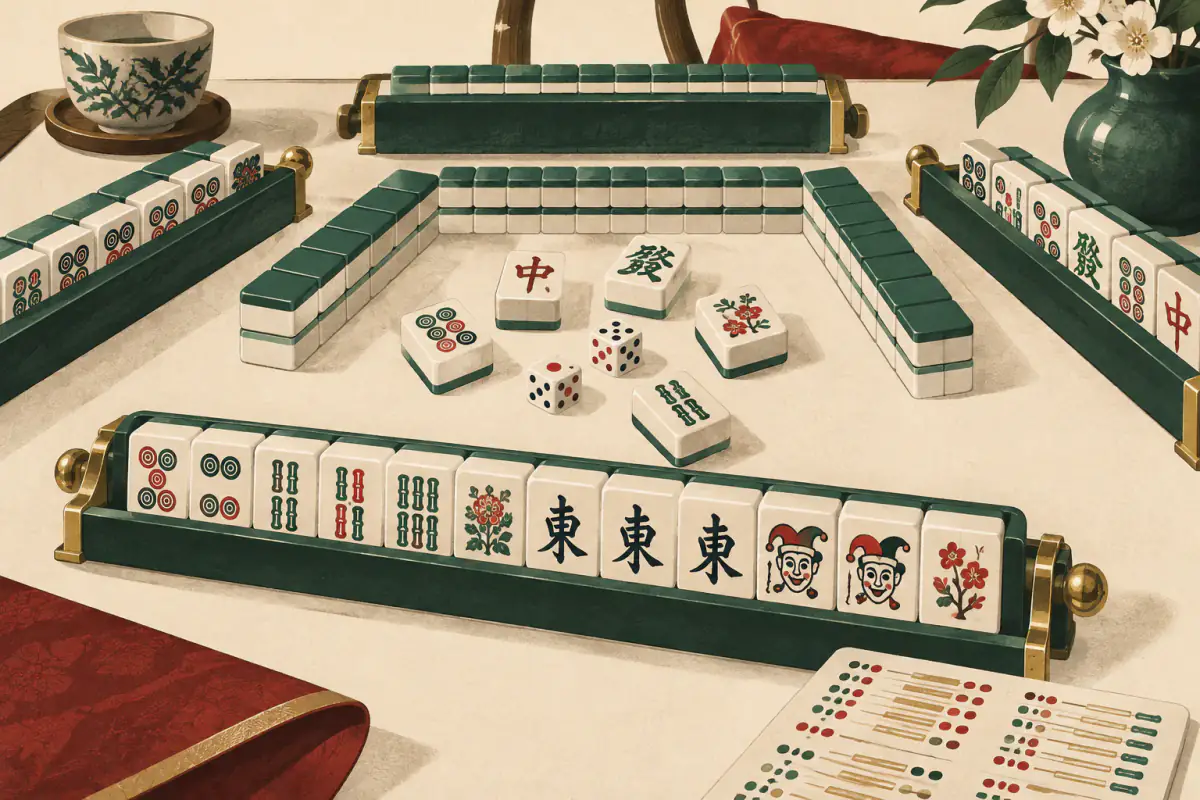
American Mahjong is a variant that developed in the United States starting in the 1920s, and differs greatly from Asian variants: instead of memorizing yaku/fan, players use an official annual card from the National Mah Jongg League (NMJL) listing valid hand combinations.
The NMJL Card Changes Every Year
Every year, the NMJL publishes a new card with slightly different hand combinations from the year before -- keeping the game fresh and pushing longtime players to keep learning new patterns.
Charleston: The Opening Tile-Passing Phase
Another distinctive feature of American Mahjong is the "Charleston" phase at the start of the game -- each player passes several tiles to other players in a specific rotating pattern before the main game begins, helping everyone get more relevant tiles.
How to Read One Line on the NMJL Card
The NMJL card writes every valid combination as a number/symbol notation, not a yaku name. A simple example line: "FF 2025 2025 DDDD" means your hand needs 2 Flower tiles (FF), then the number combination 2-0-2-5 twice from two different suits, plus a Kan of Dragon tiles (DDDD). Every line on the card also lists its point value and whether it must be concealed or can be exposed.
Joker Tiles
American Mahjong uses Joker tiles as wildcards that can substitute for any tile in certain combinations (with restrictions depending on the combination -- for example, Jokers are often NOT allowed for a single pair in some combinations) -- a concept that doesn't exist at all in Riichi, Chinese Official, or Hong Kong Mahjong.
Learn about another mahjong variant from western China.
Read About Sichuan Mahjong →