
Hong Kong Mahjong Rules for Beginners
Sep 25, 2026 · 5 min read
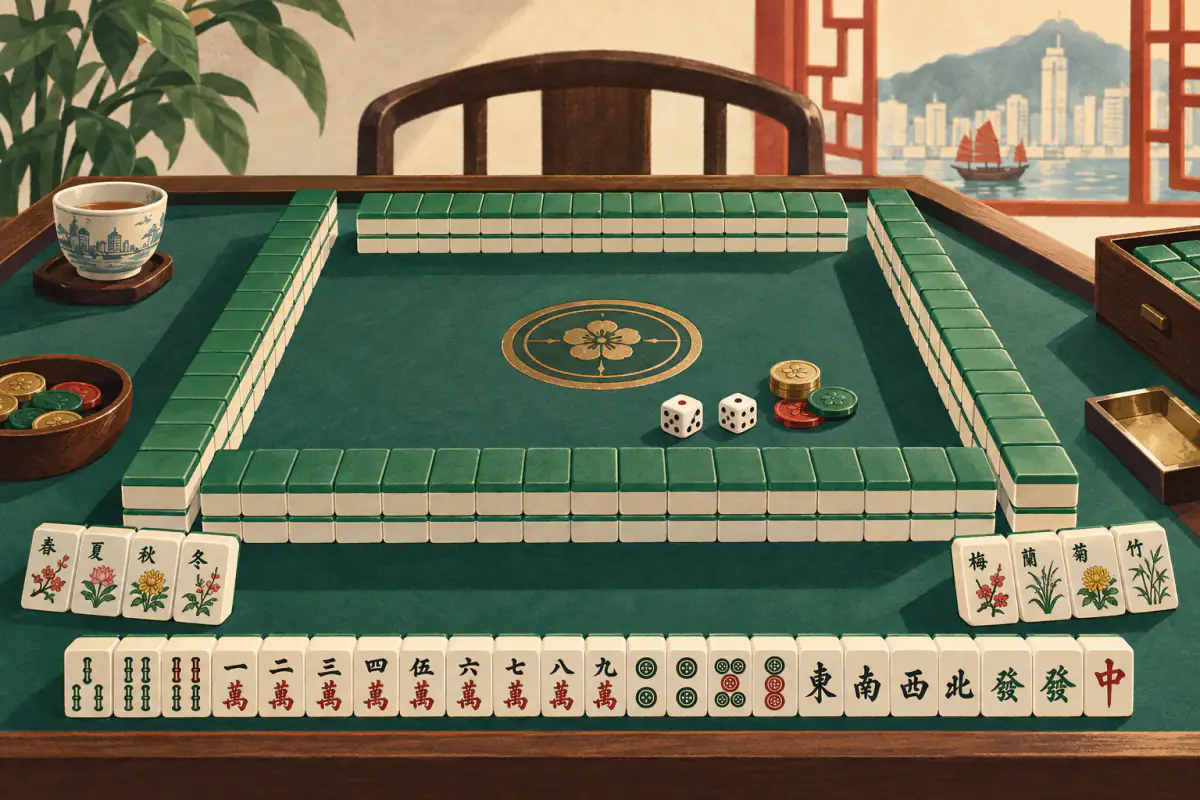
Hong Kong Mahjong (sometimes also called Cantonese Mahjong) is one of the most common rulesets played casually in Southeast Asia and southern China.
Hand Structure
Just like other rulesets, it's still 4 sets + 1 pair. The difference from Riichi: there's no riichi concept or standard dora (though some groups add flower-tile rules as bonus points).
The Fan Scoring System
Hong Kong Mahjong also uses a fan system like Chinese Official, but with a much shorter pattern list (usually just 10-20 common patterns, versus 80+ in Chinese Official). The difference from Chinese Official: scoring isn't a linear sum, it's a DOUBLING of a base point value -- similar logic to Riichi, just without the fu component.
| Total Fan | Points (base 2) | Points (base 4) |
|---|---|---|
| 1 fan | 4 | 8 |
| 2 fan | 8 | 16 |
| 3 fan | 16 | 32 |
| 4 fan | 32 | 64 |
| 5 fan (usually a limit) | Agreed limit value | Agreed limit value |
The base point value (2 or 4 in the example above) MUST be agreed upon before playing -- this is one of the most common house-rule variations. The higher the base, the bigger the stakes on every win.
Chicken Hand
One distinctive feature of Hong Kong Mahjong: many groups allow a "Chicken Hand" -- a hand with no fan at all can still win, just paid at a minimum value. This is entirely different from Riichi, which requires at least 1 yaku.
Read about Hong Kong Mahjong's distinctive special hands.
Read About Special Hands →